
Product behaviour
Viscosity, particles, foam, product temperature and shear sensitivity decide whether piston, pump or cup dosing should be compared.
A volumetric filling machine should be selected around the actual product, container and output target. This page explains when piston fillers, pump fillers and volumetric cup fillers are normally compared for UK production projects.
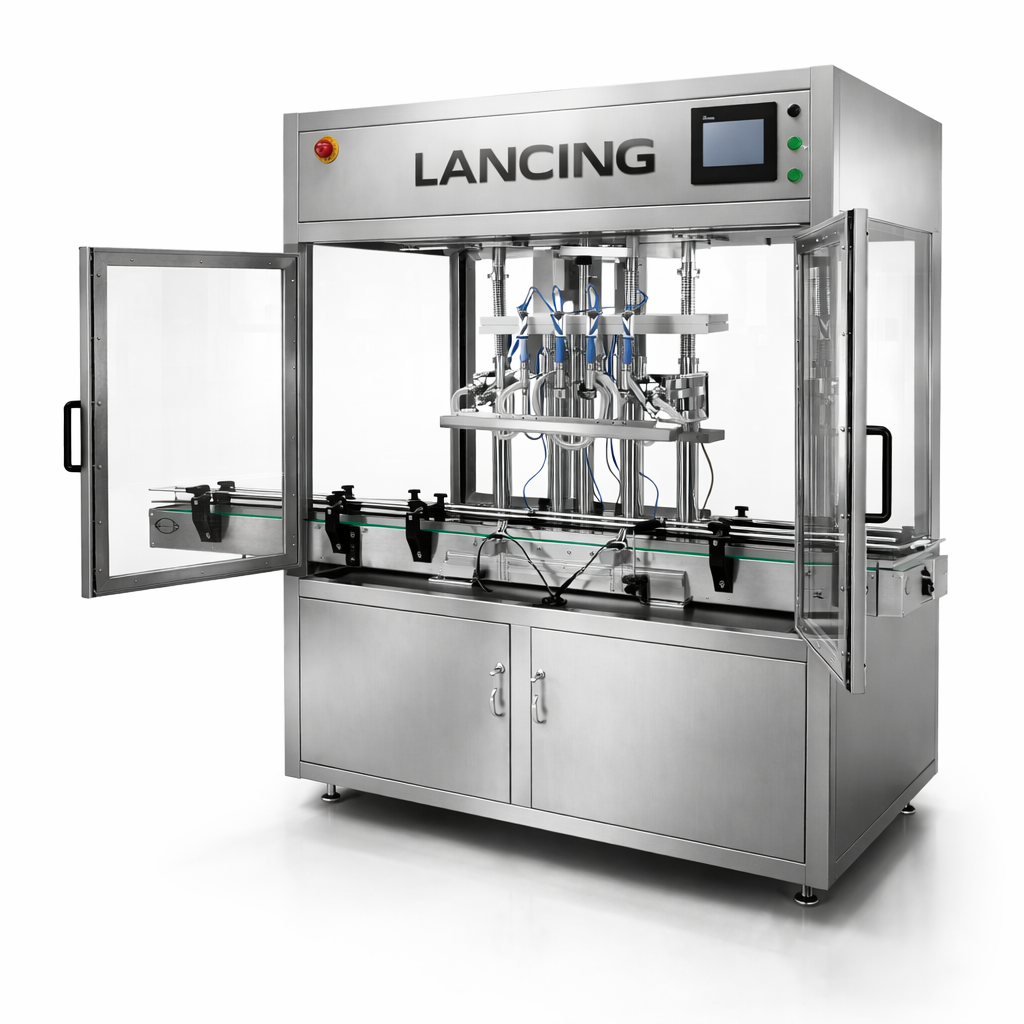
The strongest shortlist starts with product behaviour: viscosity, foam, particulates, fill size, cleaning and whether the filler is standalone or part of a packaging line. Lancing UK can help compare compact, semi-automatic and inline volumetric filling options.
These checks improve the match between the product, filling method and production layout before quotation.
Viscosity, particles, foam, product temperature and shear sensitivity decide whether piston, pump or cup dosing should be compared.
A machine has to suit the smallest and largest fill size, not just the average container in the range.
Bottle neck size, jar opening, container stability and conveyor handling determine nozzle and gating choices.
Food, cosmetic and chemical projects all need a realistic plan for cleaning access and product contact parts.
The strongest enquiry usually compares two or three realistic machine routes against the real production conditions.
A strong route for repeatable measured filling of liquids and pastes, especially when the product is viscous or needs positive displacement.
Often considered for free-flowing liquids, product-sensitive filling or where tubing changes can simplify cleaning.
Usually compared for free-flowing granules where each cycle doses a measured cup volume rather than a liquid displacement.
| Best-fit searches | volumetric filling machine UK, volumetric filler, piston filler, liquid filling machine, paste filling machine, cup filler |
| Useful products | Sauces, creams, gels, oils, detergents, honey, lotions, granules, beans, seeds and similar products after testing. |
| Main decision | Match the filling principle to product behaviour before choosing the automation level. |
| Next step | Send product details, fill range, container photos, cap/lid route and target output. |
Better production details allow Lancing UK to narrow the filler route quickly and avoid unsuitable catalogue-style recommendations.
Viscosity, particles, temperature, foam, shear sensitivity, hygiene and cleaning expectations.
Bottle, jar or container dimensions, neck opening, fill range and closure type.
Target output, available footprint, utilities, operator level and future expansion plans.
Use these related pages to compare machine types, product behaviour and the information needed before quotation.
It is a filling machine that dispenses a measured volume of product into each container. The measured volume may be controlled by piston displacement, pump movement, timing, cup dosing or another repeatable volumetric method.
It can be highly repeatable when the product, fill volume, nozzle, product supply and container handling are matched correctly. Accuracy should always be checked against the real product and production speed.
Many liquids, pastes, sauces, creams, oils, detergents and free-flowing granules can be considered for volumetric filling. Powders and variable-density products may need auger or weigh-based comparison.
Yes. Lancing UK can plan volumetric filling with conveyors, capping, labelling, coding, sealing, accumulation and end-of-line machinery.
Send your product, fill volume, container, throughput target and any downstream equipment needed. Lancing UK will narrow the most practical filling route before quotation.
A volumetric machine can only repeat the volume created by its measuring principle when the product reaches that element consistently and leaves through a controlled path. Cylinder or cup size, stroke, tubing, valves, feed pressure and nozzle cut-off must therefore be specified together.
The cylinder establishes the maximum swept volume and the piston stroke sets the working dose within that module. Published Lancing piston configurations use alternative modules such as 5–100, 10–300, 50–500, 100–1000, 500–3000 and 1000–5000 ml. The module is selected against the actual dose range rather than treating all ranges as one cylinder.
Peristaltic and other pump systems meter a controlled delivery cycle rather than a piston-cylinder stroke. Tube bore, occlusion, wear, product viscosity and supply conditions can alter the delivered amount, so calibration belongs to the installed tubing and recipe.
A cup captures a defined volume of dry product. The cup can repeat its volume while the delivered mass changes with bulk density or inconsistent filling of the cup. The trial must therefore check the quantity that the buyer actually controls.
| Reference | Published measurement range | Published condition | Selection implication |
|---|---|---|---|
| LU-GY1C piston configuration | 5–100 ml to 1000–5000 ml optional modules | 10–20 bottles/min and ≤ ±0.5% published accuracy; 10 mm nozzle; 0.4–0.6 MPa air | Confirm the selected cylinder, product condition, speed and measurement method during the trial. |
| LUDTPP4F peristaltic configuration | 10–500 ml recommended at 110 V or 10–1000 ml at 220 V; model-specific | Up to approximately 4000 ml/min per nozzle on water; 30–50 bottles/min and ≤ ±1% on water | These water-based conditions do not transfer automatically to a different viscosity, tube or dose. |
| LU-KL02S cup configuration | Published 1–500 g reference, customisable | 10–30 bottles/min; 30 L hopper; 20 mm outlet; measuring-cup method | The mass range is product-dependent because the machine measures volume and the bulk density sets the resulting weight. |
These answers explain the checks that normally need to be completed before a machine configuration can be confirmed.
The piston displaces the volume swept through the cylinder during the stroke. Reducing or increasing the effective stroke changes the displaced volume within the practical range of the selected cylinder.
A cylinder should place the required doses inside a controllable operating window. Using an unsuitable cylinder can reduce adjustment resolution or make the required range impractical.
Run the actual product into representative containers, measure each delivered quantity using the agreed method, adjust the dose setting and repeat until both target and variation meet the project criteria.
Suck-back briefly reverses or relieves product at the nozzle after discharge to reduce drips or stringing. It must be tuned so it improves cut-off without drawing unwanted air or product back from the container.
Yes. Gravimetric checks are often convenient, provided container tare is controlled and any conversion between mass and volume uses a representative product density at the test condition.
Retain the product and temperature, cylinder or cup, stroke or pump setting, speed, nozzle, head-specific corrections, individual results and the date of verification.
Send the required dose range and the actual product and containers so cylinder, cup, tubing and nozzle choices can be trialled together.