
Thin liquids
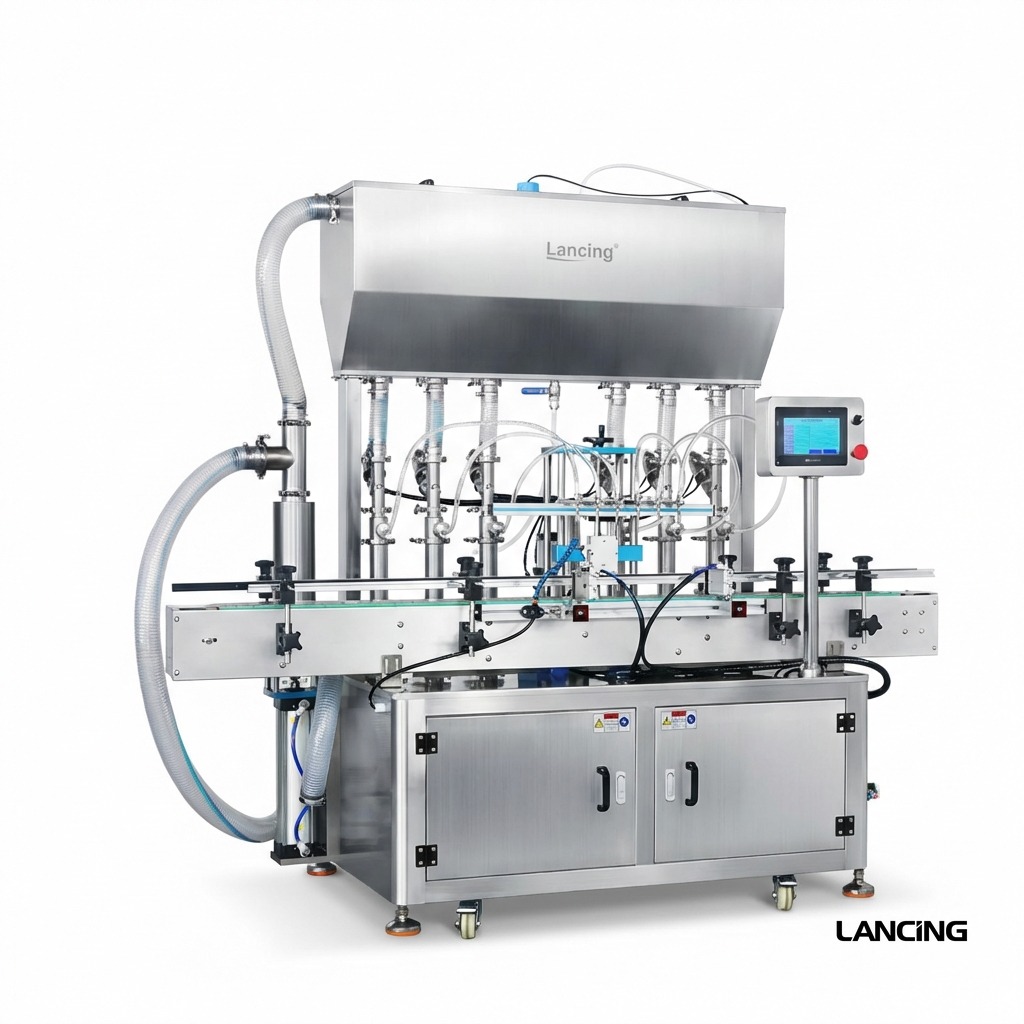
Products such as oils, detergents and water-like liquids can use pump or piston routes depending on fill volume, foaming and accuracy needs.
OilsDetergentsE-liquids
Use the product, pack format and output target to choose between piston, pump, cup, auger or weighing routes.
Products such as oils, detergents and water-like liquids can use pump or piston routes depending on fill volume, foaming and accuracy needs.
Sauces, creams, gels, honey, lotions and body-care products usually need piston or rotor-pump style control to move product cleanly.
Beans, seeds, coffee, sugar and granular products may suit volumetric cup dosing; powders may need auger or weigh dosing after flow testing.
The container affects stability, nozzle access, drip control, conveyor handling and downstream closure selection.
Liquid and paste filling routes with capping, labelling and coding integration.
Useful for sauces, spreads, creams, powders and granules where wide-mouth access changes nozzle choice.
Volumetric or weigh dosing routes where sealing quality and pack handling need to be planned together.
Open-container filling where lidding, sealing and finished presentation may be part of the scope.
Viscosity, particles, temperature, foam, settling, corrosiveness, hygiene and cleaning requirements.
Container dimensions, neck/opening, fill range, closure type, label position and downstream pack handling.
Target bottles per minute, shift pattern, available space, utilities, operator availability and future growth.
Often yes, but changeover depends on viscosity, container size, cleaning method, nozzle format and whether contact parts need to be swapped.
Yes, when contact parts, construction, cleaning access and filling principle are specified for the product and hygiene requirements.
Sometimes, but powders often need auger or weigh dosing. Free-flowing granules are normally better candidates for cup dosing.
Shortlist filling machinery by how the product behaves in the container, not just by the label on the product.
Send your product, fill volume, container, throughput target and any downstream equipment needed. Lancing UK will help narrow the best machine route before quotation.
A sauce, lotion, detergent or granule can vary substantially between recipes and operating temperatures. The specification should describe the behaviour that the machine must control rather than relying on an industry label alone.
| Observed product behaviour | What it changes | Volumetric route to investigate | Boundary or specialist route |
|---|---|---|---|
| Water-like and non-foaming | Fast flow can create splash or poor shut-off | Pump, piston or measured-flow liquid filling | Specialist liquid filler catalogue |
| Foaming liquid | Requires controlled speed, headspace and possibly a diving nozzle | Bottom-up and foam-control review | Trial the actual formulation at production temperature |
| Viscous, stringy or sticky | Feed pressure, positive displacement and cut-off become critical | Piston displacement and shut-off nozzles | Specialist paste-filling route |
| Particles or inclusions | Valve, seal and nozzle clearances can block, cut or segregate product | Particulate filling assessment | Supply representative maximum particle size and concentration |
| Free-flowing granules | Bulk density and flow into the cup affect delivered mass | Defined-volume cup dosing | Weigh filling where mass control is primary |
| Fine or cohesive powder | Dust, aeration and inconsistent flow reduce cup consistency | Compare volumetric and auger routes | Use auger or weigh-filling guidance when powder flow or direct mass control is primary |
For each formulation, record viscosity or an agreed practical flow test at the real filling temperature, particle size and concentration, foam, aeration, settling, corrosivity, abrasiveness and sensitivity to shear. The worst case should be included in the trial.
Provide container drawings or samples for the smallest and largest formats. Include neck internal diameter, shoulder profile, overall height, base stability, closure, label area and the required headspace. These details affect nozzle travel and line handling.
State batch size, shift pattern, change frequency, operator level, utilities, available footprint, target output and whether product is fed from a hopper, vessel, IBC or existing process line. Product supply can become the limiting stage.
A practical trial should include the formulation at its normal temperature range, representative particles and the final container. If several recipes will share one filler, the trial plan should deliberately cover the boundaries: thinnest, thickest, most foaming, largest particle and most demanding clean-down.
These answers explain the checks that normally need to be completed before a machine configuration can be confirmed.
Recipes can differ in viscosity, particle size, aeration, temperature, shear sensitivity and cleaning requirements. A product name is not enough to determine the dosing principle or nozzle.
Supply the products that represent the lowest and highest viscosity, the largest particles, the greatest foaming tendency and the most difficult clean-down. These boundary products normally determine the machine path.
The neck opening, headspace, stability, rigidity and surface finish affect nozzle access, splash, bottom-up movement, conveyor guides and whether product on the outside of the pack will interfere with capping or labelling.
When bulk density changes enough to move the delivered mass outside the accepted tolerance, or when the legal or commercial quantity is controlled directly by mass, weighing is usually the stronger comparison.
Only after materials, cleaning, cross-contamination, product-contact parts, guarding and process requirements have been assessed. A broad application list does not mean every product can safely share the same machine.
Send representative product and pack samples, including the difficult boundary conditions, for a method and trial review.
Application names such as sauce, lotion, detergent or granules do not define the machine by themselves. Record the product boundary, pack boundary, fill range, line state and cleaning requirement so the same application can be reproduced during selection and acceptance.
Include viscosity or bulk-density range, temperature, particles, foam, settling and the intended feed arrangement.
Include the smallest neck, least stable container, maximum fill, headspace and closure or downstream interface.
Agree individual fill measurements, operating states, cleaning observation and reasons for rejected packs.
Use the volumetric filling trial protocol and technical glossary when preparing application samples.
A trial approves only what the recorded evidence supports. A second liquid may have different density, foam, temperature or compatibility requirements, while a changeover introduces cleaning and priming conditions absent from a steady run. Group products by their actual limiting characteristics and identify which cases need separate verification rather than assuming one successful demonstration covers them all.
For sauces, agree what residue can remain in valves or nozzles after the proposed clean. For cosmetics, record fragrance, colour and formulation changeovers. For cleaning liquids, provide the relevant safety data and chemical exposure conditions. These are specification inputs, not a declaration that a machine suits every formulation.
Review cleaning evidence and product-contact compatibility alongside the existing application shortlist. Send representative products and packs for review rather than only a product-category name.