
Viscosity and texture
Confirm whether the product is pourable, thick, heated, shear-sensitive or changes viscosity during production.
Paste filling requires controlled product movement, clean cut-off and a machine route that can handle viscosity without air pockets, stringing or unreliable repeatability.
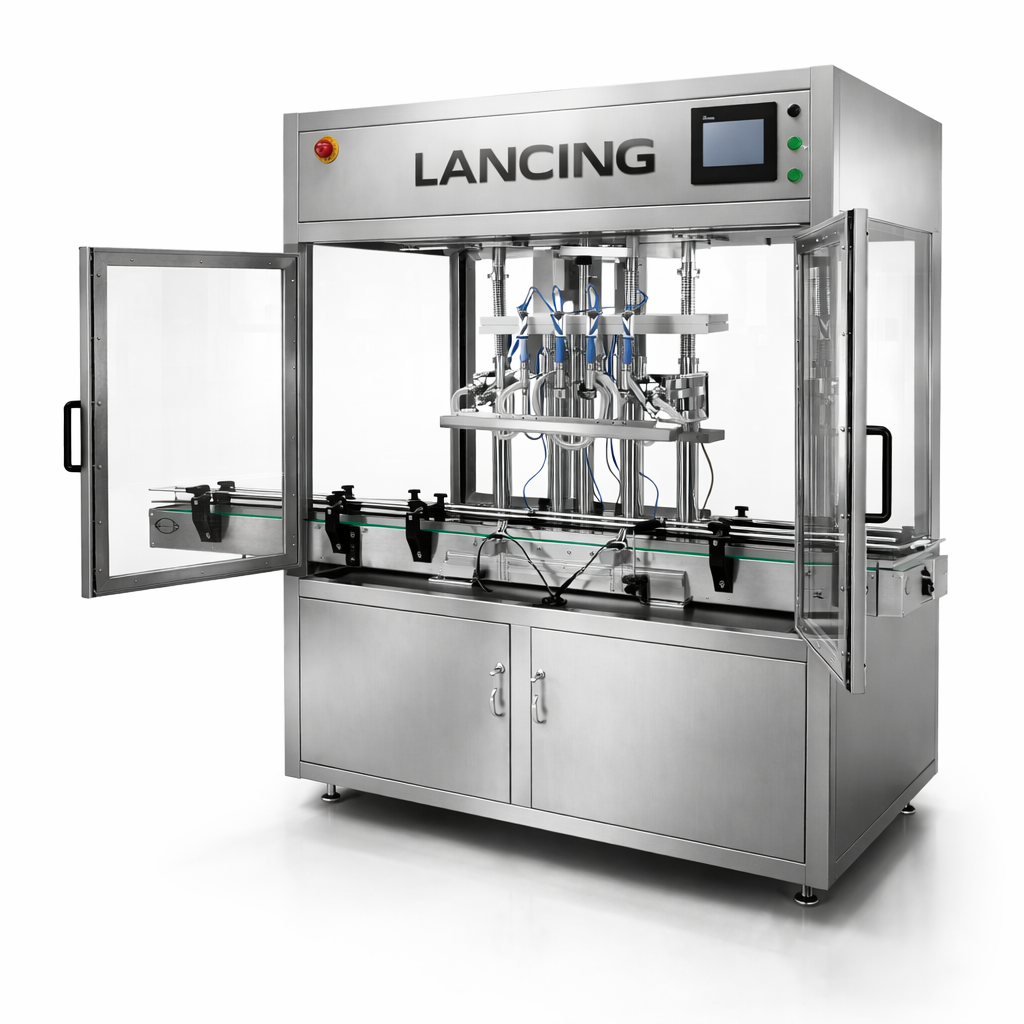
Thicker products usually need a positive displacement route. Piston and servo piston fillers are often compared where sauces, gels, creams, honey or lotions need repeatable volumetric filling.
These checks improve the match between the product, filling method and production layout before quotation.
Confirm whether the product is pourable, thick, heated, shear-sensitive or changes viscosity during production.
Thick products can trap air if supply, suction and speed are not matched correctly.
Stringing, tailing and dripping need to be considered before selecting nozzle and valve design.
Batch products need realistic cleaning, drain-down and tool-free access where possible.
The strongest enquiry usually compares two or three realistic machine routes against the real production conditions.
A common route for controlled measured fills of viscous and semi-viscous products.
Useful when recipe control, output consistency and automatic adjustment are important.
Sometimes considered for supply to the filler or for product-specific movement needs.
| Best-fit products | Sauce, honey, gel, cream, lotion, shampoo, paste, chutney, jam and viscous food products. |
| Container formats | Jars, bottles, pots, tubs and wide-mouth containers depending on nozzle access. |
| Important checks | Product temperature, particles, hygiene, drip control, filling speed and container opening. |
| Quote information | Product sample description, viscosity, fill size, pack type, output target and cleaning method. |
Better production details allow Lancing UK to narrow the filler route quickly and avoid unsuitable catalogue-style recommendations.
Viscosity, particles, temperature, foam, shear sensitivity, hygiene and cleaning expectations.
Bottle, jar or container dimensions, neck opening, fill range and closure type.
Target output, available footprint, utilities, operator level and future expansion plans.
Use these related pages to compare machine types, product behaviour and the information needed before quotation.
It is a filling machine designed to move and dose semi-viscous or viscous products such as sauces, gels, creams, honey and lotions.
Often yes. Piston fillers are a common route for viscous paste-style products because they use positive displacement to measure and discharge the fill.
Some can, but seeds, pieces or abrasive particles must be checked against the valve, nozzle and product path.
Yes. Paste fillers can run as semi-automatic machines or as automatic inline filling systems with conveyors and downstream equipment.
Send your product, fill volume, container, throughput target and any downstream equipment needed. Lancing UK will narrow the most practical filling route before quotation.
A paste can be pumpable yet still be difficult to dose cleanly. Draw speed, product feed, valve clearance, shear, trapped air and the nozzle determine whether the measured quantity reaches the container in a repeatable condition.
Record the practical flow behaviour at the lowest and highest expected temperature. Some products thin under shear or recover structure after discharge, so a single room-temperature description is insufficient.
The hopper, transfer pump or heated supply must keep the measuring chamber full without adding air or separating the product. A consistent dose cannot be produced from an inconsistent inlet condition.
Provide the maximum particle and normal concentration. Valve and nozzle openings must pass the product while preserving texture and avoiding blockage, crushing or segregation.
Stringing and tailing may need a shut-off nozzle, suck-back, larger bore or changed speed profile. The cleanest setting is established from the real container opening and presentation standard.
| Lancing reference | Published configuration | Product and cleaning evidence |
|---|---|---|
| Six-nozzle automatic paste filler | Six piston nozzles; volume modules from 5–100 to 1000–5000 ml; published accuracy ≤ ±1% reference; HMI, sensors and integrated conveyor | Published applications include creams, sauces and lotions. Heated/mixed hopper options, anti-drip nozzles and tool-less strip-down are listed, but the actual residue and particles must be trialled. |
| Rotor lobe volumetric filler | Published approximate range 5–5000 ml; custom head count; stainless construction; heated hopper or jacketed-line options | Presented for viscous or chunky products with product-dependent accuracy. Shear, particle passage, CIP/SIP scope and the dosing control need project confirmation. |
| Four-head automatic piston filler | Four heads; 5–100 to 1000–5000 ml modules; published accuracy ≤ ±1% reference; anti-drip nozzles | Suitable reference for honey, sauces, creams and lotions after product, temperature, cylinder, feed and nozzle review. |
For a broader range of specialist paste-filling configurations, review Paste Fillers UK.
These answers explain the checks that normally need to be completed before a machine configuration can be confirmed.
Many pastes change viscosity as temperature changes. A filler set with a warm product may draw, discharge and cut off differently when the product is colder.
Cavitation or incomplete cylinder filling can occur when the product cannot enter the measuring chamber fast enough. It can create air pockets, low fills and variation, especially at excessive draw speed.
The valve and ports must pass the maximum particle without cutting, crushing or blocking it. Particle concentration and settling also affect how representative each dose is.
It may help maintain temperature, viscosity or suspension, but heating and agitation must be appropriate for the formulation and cleaning process. They are not universal requirements.
A low-shear route aims to reduce mechanical damage or texture change. The product should still be trialled because pump speed, clearances and recirculation can alter sensitive formulations.
Document drain-down, dismantling, access to dead spaces, cleaning method, reassembly and the verification required before the next product. Test the most difficult residue rather than only an easy rinse.
Send the paste at its real working temperature with representative particles, containers and clean-down requirements for a controlled trial.
A paste filling machine should be tested against the full operating envelope, not one convenient sample. Temperature, time since mixing, hopper level and particle distribution can change draw, pressure, nozzle cut-off and the amount retained in the product path.
| Trial condition | What to observe | Why it changes the specification |
|---|---|---|
| Cold permitted product | Draw time, incomplete chamber fill, pressure, stringing and nozzle closure | The cold condition may set the largest cylinder, slowest stroke or greatest feed assistance needed for the agreed range. |
| Normal production temperature | Repeatability, cut-off, product presentation and stable cycle time | This is the principal operating point for recipe development and acceptance sampling. |
| Warm permitted product | Drip, splash, valve leakage, seal behaviour and overrun after shut-off | Lower viscosity can expose leakage or cut-off problems that are not visible when the product is colder. |
| Minimum and maximum particle load | Valve passage, nozzle clearance, particle damage, separation and blockage | Average particle content can hide the most demanding batch condition. The largest pieces and highest concentration should be represented safely. |
| Low normal hopper or supply level | Air entry, starvation, inconsistent draw and head-to-head supply | The feed arrangement must remain stable across the intended operating level, not only with a full hopper. |
| Restart after a planned pause | First-fill quantity, settled particles, skin formation, drip and delayed discharge | Restart behaviour defines priming, agitation, recirculation or rejection procedures needed in real production. |
A useful record describes the product in operational terms: temperature, time since preparation, mixing or agitation state, visible particle size and concentration, and whether the product recovers after shear. Record cylinder or pump selection, draw and discharge speeds, valve, nozzle bore, suck-back or shut-off, hopper level and the exact container used.
Watch for incomplete cylinder charging, cavitation, bridging above the inlet and separation in the supply vessel. Where a transfer pump or agitated hopper is proposed, test its effect on product texture and particle distribution.
Assess the complete dose, tail length, stringing, drip and product left on the neck or label area. A wider nozzle may reduce restriction but must still fit the opening and close cleanly.
Measure practical product recovery, dismantling steps, retained pockets, seal access and reassembly checks. Confirm the accepted first fills after cleaning rather than assuming the previous recipe alone restores the process.
This domain owns the volumetric dosing decision, cylinder or pump selection and integration evidence. Use Paste Fillers UK for the wider specialist paste-filler catalogue. Here, the strongest supporting pages are piston filling machines, filling nozzles and cleaning and changeover guidance.
Send representative samples, temperature range, particles, containers and cleaning expectations so Lancing can define a trial that reflects production rather than a single ideal batch.
Paste filling should be specified around the product condition that reaches the cylinder, valve and nozzle during production, not only around a viscosity label.
Product temperature can change viscosity, suction time, valve pressure, nozzle flow, stringing and the amount of product retained in the path. A warm sample may fill cleanly while the same formulation becomes slow or unstable at a lower approved temperature. Trials should therefore use the production temperature range and record the condition beside the accepted settings.
The viscosity guide explains why temperature must be treated as a process variable.
Particles pass through the inlet and directional valve before they reach the nozzle. A particle that fits the nozzle can still bridge, become trapped, be cut or prevent a valve from sealing correctly. The largest normal particle, concentration, shape and fragility should be tested through the complete product path, including suction and switching, not only through a loose nozzle sample.
Inspect the filled product as well as the machine for signs of damage or separation.
Stringing can result from cohesive product behaviour, unsuitable nozzle diameter, slow shut-off, insufficient or excessive suck-back, product temperature, retained pressure or the distance between the nozzle and pack. The correction must preserve dose stability and avoid drawing air or product back from the container. Film the cut-off and record the exact valve and nozzle settings.
Use the nozzle guide to compare shut-off, suck-back and diving movement.
Trial agitation when particles settle, the product separates or the feed condition changes during a batch. Trial heating only where the product owner approves a controlled temperature and the warmer condition is representative of production. Both features can alter viscosity, aeration, particle distribution, cleaning and safety requirements, so they should be evaluated as process controls rather than automatic upgrades.
Diagnose variation patterns · Review product feed · Check the pack and nozzle interface · Plan a controlled trial
Send representative product, particles, temperatures, containers and cleaning requirements so the complete paste path can be assessed.
Use representative product temperature, particles and cleaning conditions when comparing a paste-filling route.
A paste can be much harder to draw, discharge and cut off at one end of its operating range. Use the temperature guide to define the trial condition.
Review the complete path, including seals, hoses, valves and nozzle, against both product and cleaners. See the materials guide.
Faster draw or discharge can introduce air, increase stringing or overload the nozzle. The speed guide explains how to test accepted output.
State product temperature, dose, head, settings and measurement method, then report both process centring and spread. See accuracy versus repeatability.
Confirm the product at its real temperature and particle condition before using a reference speed, accuracy or dose family as a project requirement.