
Above-neck filling
Can simplify movement and cleaning, but may increase splash, foam or stringing where the product falls a long distance.
Specify the actual container dimensions and tolerances, including internal neck opening, total height, shoulder shape, stability and usable headspace. The nozzle must enter or sit above the pack with enough clearance to avoid contact while still controlling splash, foam, drips and product presentation.
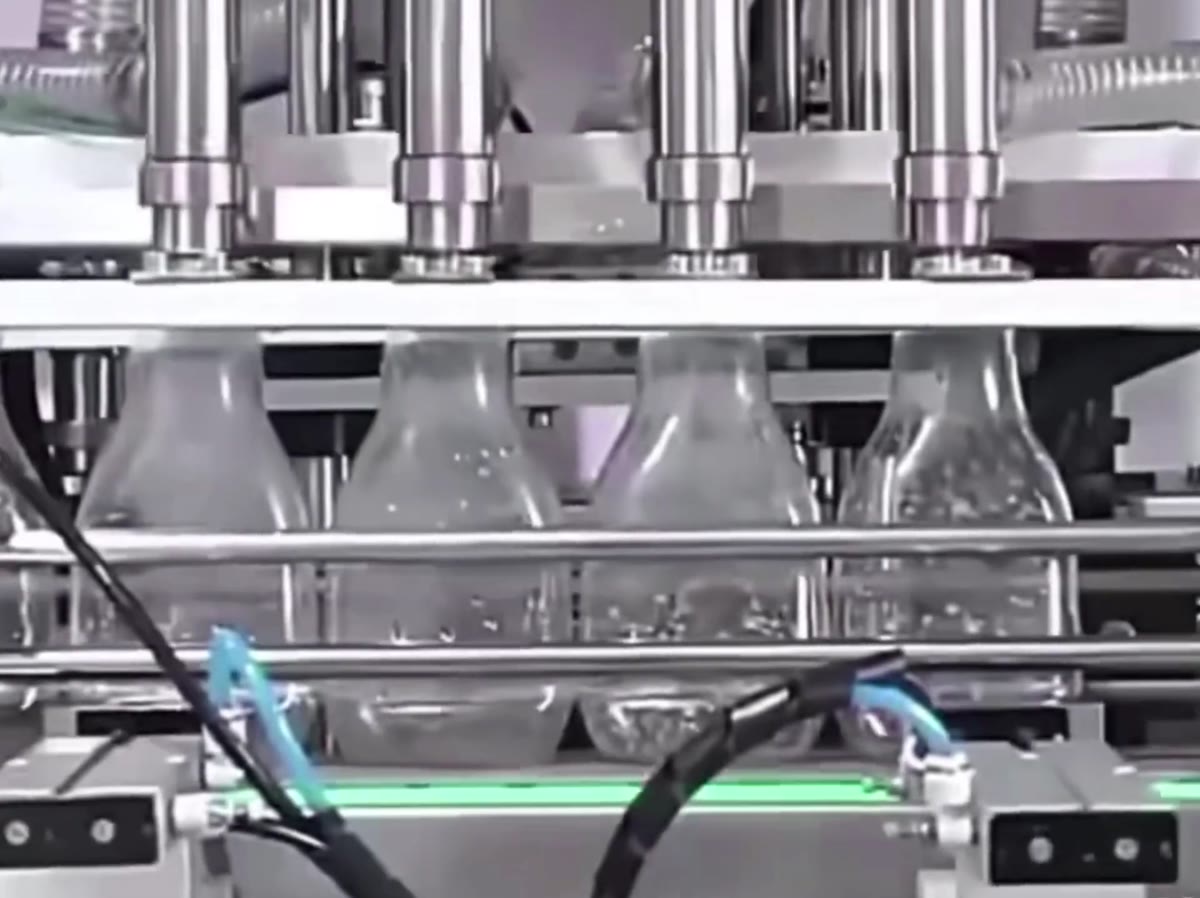
Two containers with the same stated capacity can have different necks, shoulders, headspace and conveyor stability. Those differences affect nozzle diameter, insertion, fill height, gating, splash control and the time needed to present the pack accurately.
A narrow neck can require a smaller nozzle, more accurate container positioning and a slower product velocity to prevent splash, back-pressure or contact. Thick product may also need more time to pass through the reduced opening. The practical limit is set by the complete combination of product flow, nozzle passage, container tolerance and filling movement rather than the neck diameter alone.
| Pack feature | Possible filling effect | Evidence needed |
|---|---|---|
| Small internal neck opening | Restricts nozzle and product passage | Actual minimum opening and largest product particle |
| Low headspace | Raises risk of splash or nozzle contact | Target fill level and container capacity tolerance |
| Unstable base | Requires guides, gating or support | Empty and filled stability on the intended conveyor |
| Variable height | Changes nozzle clearance or insertion depth | Representative minimum and maximum container heights |
A diving-nozzle trial should use the shortest and tallest acceptable containers, including realistic base and neck variation. Verify clearance at entry, the lowest fill position, the lift profile and withdrawal without touching the pack or dragging product onto the neck. The accepted movement should be recorded with the actual nozzle, container and product rather than inferred from a nominal drawing alone.
Can simplify movement and cleaning, but may increase splash, foam or stringing where the product falls a long distance.
Can reduce free fall and foam for suitable products, but adds positioning, clearance and motion-control requirements.
Supply enough containers to represent dimensional variation, line handling and the complete test sequence rather than one perfect sample. Include the smallest and largest formats, closures, any liners or induction foils, and examples from normal production supply. Container drawings are useful, but physical samples reveal flexibility, ovality, seam position and stability that a drawing may not show.
Mark the container reference, nominal capacity, target fill, closure and any known dimensional range. This keeps nozzle and guide settings tied to the correct production format.
Provide physical containers, closures, drawings where available, fill levels and known tolerances so Lancing can verify nozzle access and line handling.