
Drip and tailing
Thin liquids can drip; viscous products can tail, string or smear.
Nozzle selection affects accuracy, drip control, foaming, container cleanliness and finished presentation. It should be reviewed with the product and pack rather than treated as a small accessory.
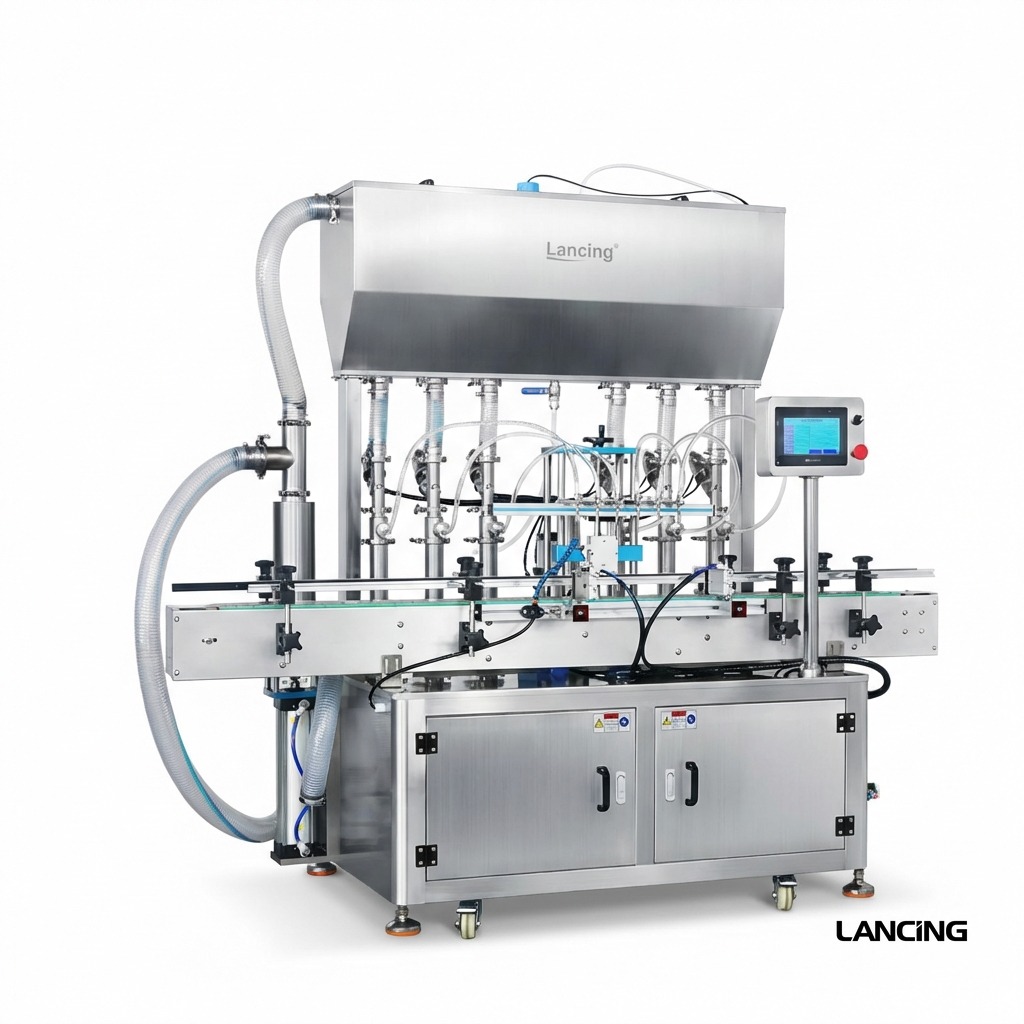
A suitable filling nozzle reduces splash, stringing, dripping and product smear. The best choice depends on viscosity, particles, fill speed, container opening and whether bottom-up filling is needed.
These checks improve the match between the product, filling method and production layout before quotation.
Thin liquids can drip; viscous products can tail, string or smear.
Some liquids need bottom-up or submerged filling to reduce foam.
Seeds, herbs or solids need a product path and nozzle opening that will not block.
Bottle neck or jar opening dictates nozzle diameter and positioning tolerance.
The strongest enquiry usually compares two or three realistic machine routes against the real production conditions.
Useful where product should stop cleanly at the end of each fill.
Used where nozzle movement helps reduce foam or splash.
Considered for thick products or products with particles.
| Best-fit products | Liquids, oils, sauces, creams, gels, shampoos, detergents and food products. |
| Common problems | Drips on the bottle, strings between fills, foam, splash, blocked nozzles or poor fill presentation. |
| Important checks | Product viscosity, particle size, fill speed, neck opening, cleaning and seal compatibility. |
| Quote information | Product details, container opening, fill height, speed expectation and current filling problem. |
Better production details allow Lancing UK to narrow the filler route quickly and avoid unsuitable catalogue-style recommendations.
Viscosity, particles, temperature, foam, shear sensitivity, hygiene and cleaning expectations.
Bottle, jar or container dimensions, neck opening, fill range and closure type.
Target output, available footprint, utilities, operator level and future expansion plans.
Use these related pages to compare machine types, product behaviour and the information needed before quotation.
Dripping can be caused by product viscosity, nozzle type, pressure, valve timing, product supply or incorrect cut-off.
A diving nozzle moves into or near the container during filling and is often considered for foaming or splash-sensitive products.
Often yes, especially when sauces are thick or contain herbs, seeds or pieces.
It can improve repeatability by reducing splash, air, foam and inconsistent product cut-off.
Send your product, fill volume, container, throughput target and any downstream equipment needed. Lancing UK will narrow the most practical filling route before quotation.
Nozzle selection should be tested with the dosing method, product and container. A clean numerical dose can still create an unacceptable pack if the nozzle drips onto the neck, traps air, foams or smears the label area.
| Nozzle approach | Reason to compare it | Failure modes to observe |
|---|---|---|
| Shut-off / anti-drip | Close the product path near the outlet for liquids, sauces, creams or gels | Seat leakage, trapped product, particles preventing closure and cleaning access |
| Suck-back | Relieve the product column after dosing to reduce drip or stringing | Air drawn into the nozzle, dose disturbance, product retraction from the container or inconsistent restart |
| Diving / bottom-up | Reduce fall distance, foam and splash while the liquid level rises | Nozzle collision, incorrect motion timing, product coating the nozzle and cycle-time increase |
| Wide-bore | Reduce restriction and allow compatible particles to pass | Excess flow, splash, poor shut-off, limited access through a narrow neck |
| Small-bore precision | Control suitable small doses or narrow openings | High velocity, restriction, blockage, pressure sensitivity and slow fill time |
The Lancing LU-GY1C piston configuration lists a 10 mm filling nozzle, while the LU-KL02S cup filler lists a 20 mm outlet with other sizes customisable. These are machine-specific references, not universal recommendations.
A different viscosity, particle size, container neck or speed can require another bore and shut-off arrangement. The test should compare quantity and presentation together.
The existing Lancing machinery clip shows an inline filling-head arrangement and container presentation. It is useful visual evidence for discussing nozzle position and line layout; it is not presented as a measured accuracy test.
Record the nozzle type and bore, product temperature, fill speed, height, diving movement, shut-off and suck-back settings. Capture the end of discharge from the side and above where safe, then inspect the neck, shoulder, cap area and label panel. Repeat after a production pause because drip and air entry often appear at restart.
Check whether the nozzle setting changes individual fill results or creates head-to-head restriction. Do not optimise presentation by introducing unacceptable quantity variation.
Define acceptable drip, stringing, splash, foam and external contamination. Confirm that the closure and label can be applied without wiping or rework.
Review trapped product, disassembly, seals, crevices, particle retention and safe access. A complex shut-off can improve cut-off but add cleaning work that must be included in the changeover.
These answers explain the checks that normally need to be completed before a machine configuration can be confirmed.
An anti-drip nozzle uses a shut-off mechanism at or near the outlet. Suck-back reverses or relieves a small amount of product after the dose. They may be used separately or together depending on the product.
A smaller bore can increase velocity and pressure, creating foam, splash or excessive restriction. It may also block particles. Nozzle size should be selected from product flow and container opening, not only neat appearance.
Diving or bottom-up motion is compared when foam, splash, long fall distance or a narrow opening makes top filling unstable. The motion profile must remain clear of the product and container.
Observe the end of discharge at normal speed and after pauses. Record drip, stringing, air draw-back, product on the container and any effect on cap or label application.
Rarely. Bore, shut-off style, seals, materials, particle clearance and cleaning can require different nozzles or change parts across a product range.
Record nozzle type, bore, height, speed profile, suck-back or shut-off setting, product temperature and the fill results so the condition can be reproduced.
Send the container neck dimensions and a representative product so nozzle bore, shut-off and motion can be tested with the dose.
The nozzle setting should be reproducible after changeover. Container neck dimensions, nozzle outside diameter, insertion depth, bottom clearance and motion timing determine whether the dose reaches the pack cleanly without contact, foam, splash or trapped product.
| Format parameter | Record | Trial evidence |
|---|---|---|
| Container neck | Internal opening, external neck, shoulder position and dimensional variation | Confirm the smallest acceptable opening and the most unstable container can be presented without contact. |
| Nozzle geometry | Outside diameter, outlet bore, tip shape and shut-off mechanism | Check clearance, flow restriction, particle passage, clean closure and cleaning access. |
| Static height | Tip height above the opening or product surface at the start and end of fill | Observe fall distance, splash, foam and product on the neck or shoulder. |
| Insertion and bottom clearance | Maximum insertion and minimum clearance from the container base or internal feature | Prove that normal container tolerance and conveyor movement cannot cause a collision. |
| Diving movement | Start point, end point, speed, delays and relation to product level | Film the movement and confirm the nozzle does not drag through product or withdraw too early. |
| Fill-speed profile | Initial, main and final speed stages where adjustable | Compare cycle time with foam, splash, air entrapment and cut-off quality. |
| Shut-off and suck-back | Valve timing, retraction amount or setting and post-fill delay | Inspect drip, stringing, air draw-back, dose disturbance and restart consistency. |
Video transcript: Short close-up of a multi-head filling assembly above clear bottles on an inline conveyor. The nozzles lower towards the bottle openings and rise again as the containers remain guided beneath the filling station. No measured output or accuracy result is shown.
The clip supports a practical discussion about container presentation, nozzle alignment and vertical movement. It does not identify the product, fill quantity, cycle rate, tolerance or final nozzle specification, so those points must be established through the controlled trial.
Where safe, film from the side to show height and movement, and from above or at an angle to show alignment with the opening. Keep the container format and speed visible in the trial record.
Repeat the observation after a normal production stop. Product pressure, settling, skin formation or air entry can make the first resumed cut-off different from steady filling.
Store nozzle part, height, movement, speeds, delays and suck-back with the container format. After changeover, verify clearance mechanically and confirm an accepted sample before release.
Use anti-drip nozzle guidance when shut-off is the main problem, bottom-up filling where foam or splash requires motion, and piston filling when the valve, cylinder and nozzle must be assessed as one product path.
Send container dimensions, representative samples and the required dose so Lancing can test clearance, movement, cut-off and pack cleanliness together.
Nozzle behaviour cannot be separated from upstream leakage, valve closure, piston seals, pressure or retained product. A clean steady-running cut-off should be repeated after a planned stop, a refill and the slowest approved product condition.
See piston filler valve selection and the controlled trial protocol.
Check the nozzle with the container opening, product behaviour and upstream dosing method.