
Minimum-dose check
Run enough fills to expose adjustment sensitivity, nozzle cut-off and the influence of any air pocket or valve dead volume.
A piston filler measures product by cylinder displacement. The selected cylinder or volume module must cover the required dose without forcing the machine to operate at an impractical minimum or maximum stroke.
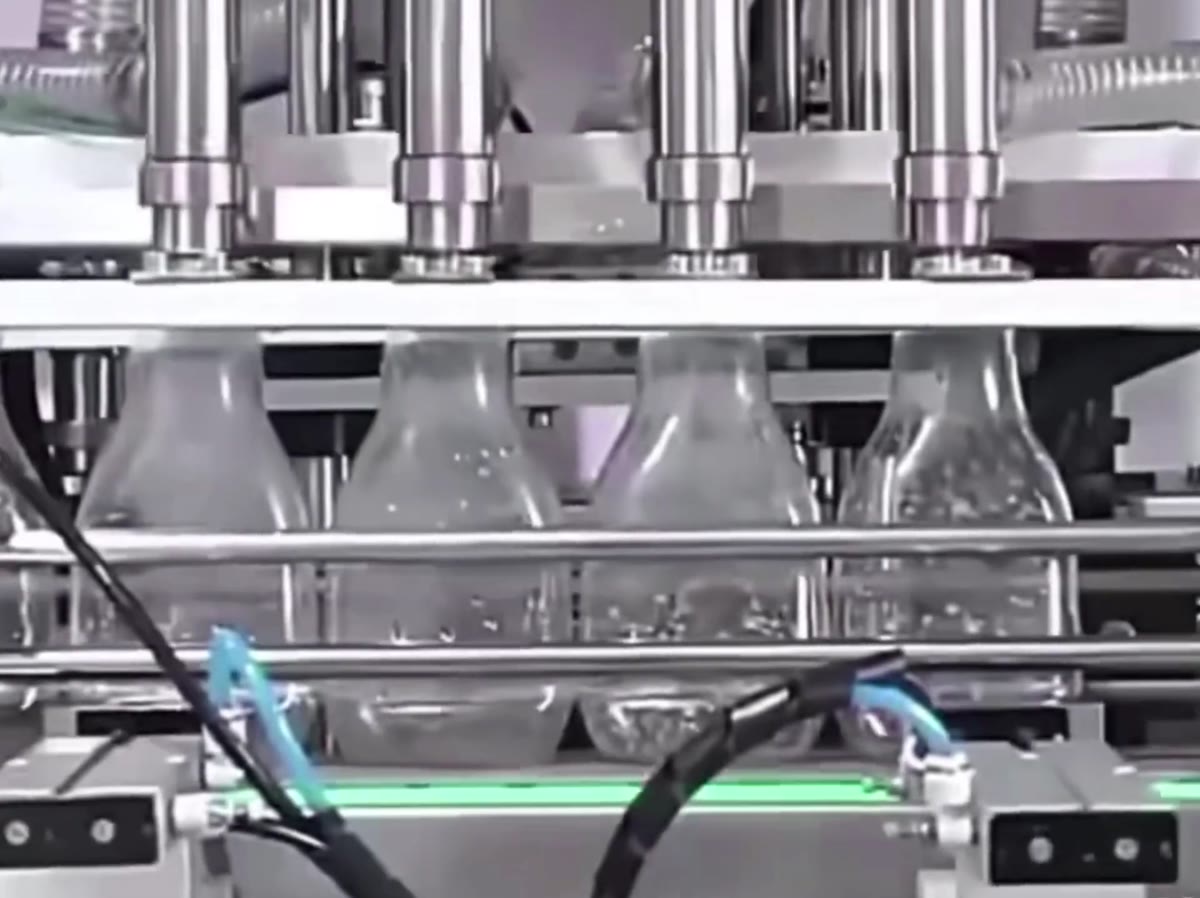
The useful decision is not the label on the machine. It is whether the product, dose, pack, utilities and acceptance method can be controlled together under realistic production conditions.
The current Lancing VF manual identifies maximum-volume codes of 0120, 0300, 0500, 1000 and 5000 ml for the VF range. It also lists Compact configurations including 10–100, 10–200, 30–300, 50–500 and 100–1000 ml. Exact availability and the usable window depend on the quoted model, cylinder, valve and controls.
| Selection question | Why it matters | Evidence to record |
|---|---|---|
| Smallest required dose | A very short stroke can reduce adjustment resolution and magnify the effect of valve clearance, air or retained product. | Repeated fills at the lowest production dose, not only the nominal middle setting. |
| Largest required dose | A near-full stroke can increase refill time and leave little operating margin for product variation. | Maximum dose at the coldest or most viscous approved product condition. |
| Product compressibility or aeration | Entrained air can make a mechanically repeatable stroke deliver an unstable net quantity. | Product preparation, hopper level, rest time and visible air in the feed path. |
| Particles and valve passage | The cylinder may cover the dose while the valve or nozzle still restricts or damages inclusions. | Largest normal particle, particle concentration and post-trial product inspection. |
One cylinder can sometimes span several pack sizes, but the best engineering choice is based on usable stroke, product refill behaviour and the accuracy required at both ends of the range. Selecting a very large cylinder only because it covers the biggest pack can make the smallest dose difficult to set and verify. Selecting a small cylinder for a large dose can lengthen the cycle or require multiple strokes.
Run enough fills to expose adjustment sensitivity, nozzle cut-off and the influence of any air pocket or valve dead volume.
Confirm suction time, hopper recovery, cylinder refill and the time available before the next container is presented.
Compare the cost and changeover effort of a second cylinder or module with the production compromise of one extreme operating range.
Related guidance: piston filling machines, accuracy and repeatability and the volumetric filling trial protocol.
These answers define the evidence normally needed before Lancing can confirm a machine configuration.
Not necessarily. A mechanically possible short stroke may offer poor adjustment resolution or an unstable result with the real valve, nozzle and product. The smallest required dose should be tested.
A second cylinder or volume module can be useful when the required dose span is very wide, when minimum-dose control is weak, or when the largest dose makes refill time impractical.
No. Cylinder size determines displaced volume; nozzle and valve passages are selected around product flow, particles, foam, cut-off and container opening.
Record repeated fills at the required range boundaries using the production product, feed arrangement, container and intended operating settings.
Send the fill range, product condition, container details and output target so Lancing can shortlist the practical cylinder and stroke window.