
Pressure check
Measure at the machine while it cycles, not only at the compressor or plant header. Pressure drop and regulator recovery can affect timed delivery.
A piston measures quantity by displacement. A time-pressure filler delivers product for a controlled time from a pressurised supply. Both can be useful, but they respond differently to pressure, viscosity, nozzle restriction and dose size.
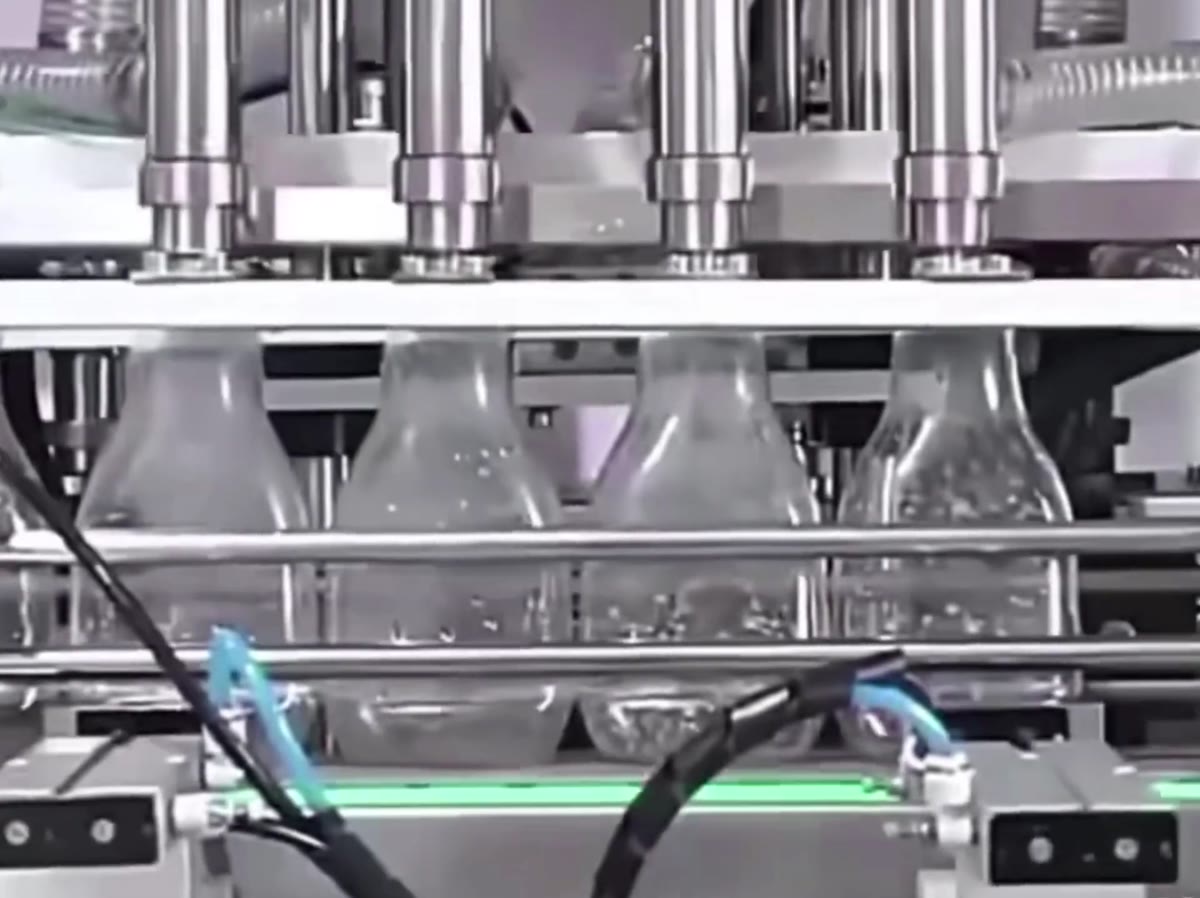
The useful decision is not the label on the machine. It is whether the product, dose, pack, utilities and acceptance method can be controlled together under realistic production conditions.
| Factor | Piston filling | Time-pressure filling |
|---|---|---|
| Dose control | Cylinder displacement and stroke define the nominal volume. | Pressure, time, nozzle restriction and product flow define the delivered quantity. |
| Product path | Cylinder, piston seals, directional valve and nozzle. | Pressurised vessel or supply, tubing, control valve and nozzle. |
| Small doses | Requires a suitably small cylinder and stable valve/nozzle action. | Can be useful where short, controlled delivery through a compact path is repeatable. |
| Viscosity change | Can change suction and discharge time even when displacement remains fixed. | Can directly change flow during the timed interval and therefore the delivered quantity. |
| Supply variation | Hopper level and suction conditions still matter, particularly with thick or aerated product. | Pressure stability and product head are central to repeatability. |
| Changeover | Requires cleaning of cylinder, valves, hoses and nozzle. | May offer a shorter path, but vessel, tubing, valve and nozzle still require verified cleaning. |
For time-pressure dosing, record the product temperature, supply pressure, vessel level, tube and nozzle size, valve open time and delivered quantity. Repeat the calibration after a refill, a production pause and any product-temperature change. For piston filling, record the cylinder or module, stroke, valve, nozzle and product condition.
Measure at the machine while it cycles, not only at the compressor or plant header. Pressure drop and regulator recovery can affect timed delivery.
Observe tailing, drip and retained product. The smallest dose can be dominated by valve and nozzle response rather than the programmed time.
Run the approved temperature range because viscosity change can alter flow through a fixed restriction.
Time-pressure dosing may be a poor fit where supply pressure changes substantially, product viscosity moves during the shift, particles block the small path, or a wide fill range requires very different settings. A piston may be a poor fit where product contact with a cylinder and directional valve is undesirable or the required micro-dose is below a practical module window. Peristaltic or another pump route may also deserve a controlled trial.
Compare piston and peristaltic filling, review liquid filling routes, and use the trial protocol.
These answers define the evidence normally needed before Lancing can confirm a machine configuration.
It can be calibrated to deliver a repeatable volume, but the quantity is created by controlled pressure, time and flow restriction rather than a positive-displacement cylinder.
Product viscosity, temperature, supply pressure, vessel level, tubing, nozzle restriction, valve response and entrained air can all change the delivered amount.
That depends on the actual design. Time-pressure systems can have a short disposable or cleanable path; piston systems have a cylinder, valves and nozzle. Cleaning must be evaluated on the supplied configuration.
No. The setting must be calibrated for the actual product, pressure, temperature, tubing and nozzle.
Send the dose, product viscosity range, pressure supply, container opening and clean-down requirements for a piston, time-pressure or peristaltic comparison.