
Operator workflow
Decide how containers will be loaded, filled, removed and checked.
Semi-automatic fillers are useful when output needs to improve but a fully automated conveyor line is not yet justified. They keep operator control while making fill volume, cut-off and repeatability more consistent.
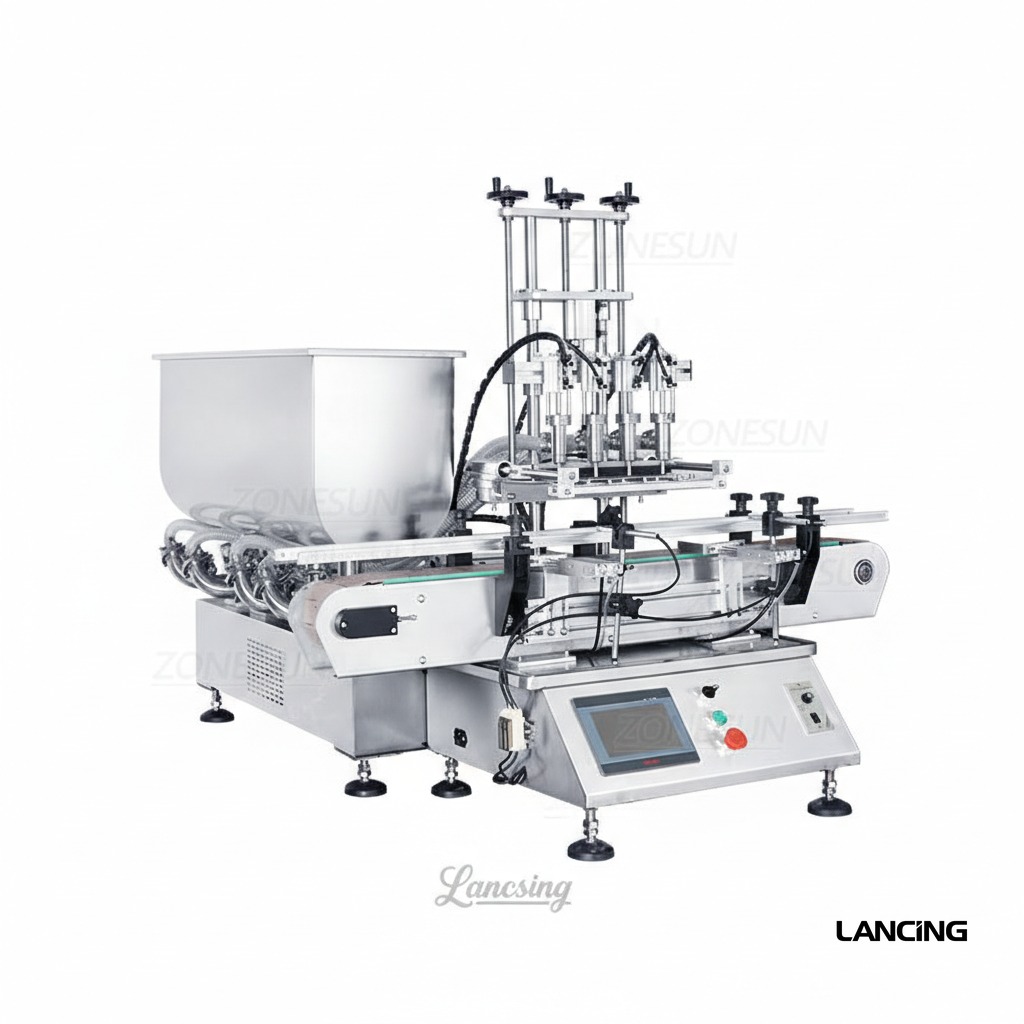
A semi-automatic filling machine can be a strong step between manual filling and full automation. It is often suitable for short runs, product trials, seasonal production and companies that have frequent product or pack changes.
These checks help Lancing UK narrow the correct filling method, machine format and line layout before quotation.
Decide how containers will be loaded, filled, removed and checked.
Short-run production benefits from simple cleaning, settings and product changeover.
Machine format depends on container size, product supply and available floor space.
The same product data can help plan a later automatic route if output grows.
There is rarely one universal filler for every product. The shortlist should compare the practical filling routes against real production conditions.
For smaller output, samples and careful product control.
For faster operator-supervised filling with multiple containers.
For validating product behaviour before investing in full automation.
| Best-fit products | Short-run liquids, creams, sauces, gels, oils, hand-filled product ranges |
| Machine routes | Single-head, twin-head, four-head, pneumatic or pump-based systems |
| Important checks | Batch size, changeover frequency, operator workflow, fill range, cleaning needs |
| Typical next step | Send product type, fill volume, batch size and target containers per hour |
Use these pages to compare product groups, machine types and automation routes.
Choose semi-automatic filling when manual filling is too slow or inconsistent but the production case does not yet require a full conveyor line.
Many can, provided the correct pump or piston route is selected for viscosity, particles and nozzle cut-off.
It may not always be physically upgraded, but the production data helps specify a later automatic filler or line.
Send your product, fill volume, container, throughput target and any downstream equipment needed. Lancing UK will narrow the most practical filling route before quotation.
A semi-automatic volumetric filler is only productive when dosing, container handling, product replenishment, inspection and changeover work as one repeatable cycle. The machine should therefore be shortlisted from the real product and pack sequence, not from a nominal fill speed in isolation.
| Published Lancing reference | Reference data | What the production trial must confirm |
|---|---|---|
| LU-GT1 single-nozzle piston filler | Published volume options run from 10–100 ml through to 1000–5000 ml; 5–20 bottles/min and ≤ ±0.5% are stated for that configuration. | Product draw, operator presentation, nozzle cut-off, actual fill range, air supply and repeatability with the proposed product and container. |
| LU-YTPP2W twin peristaltic filler | Manual and automatic modes are published, with pedal operation in manual mode, 4 or 12 L/min × 2 maximum flow references based on water and a 10 mm nozzle reference. | Tube compatibility, pump selection, fill time at the required dose, liquid behaviour, tubing life, container handling and the effect of start/stop operation. |
| LU-GY1C conveyorised single-head piston filler | Published options run from 5–100 ml through to 1000–5000 ml, with 10–20 bottles/min and < ±0.5% stated for the reference configuration. | Whether the conveyor reduces handling time, how containers are located under the nozzle, product supply stability and whether downstream equipment can accept the flow. |
These are model-specific published references, not universal guarantees. Volume, output and accuracy depend on the selected cylinder or pump, product behaviour, fill quantity, container handling, settings and agreed test method.
Record container pickup, positioning, pedal or start command, fill time, nozzle clearance, removal, closure handling and inspection. A fast dose can still create low output if the operator waits for product cut-off, repositions unstable containers or wipes contaminated necks.
Run a controlled sample with one trained operator, then record waiting time caused by replenishment, container supply and finished-pack removal. This shows whether the next improvement should be another nozzle, better fixtures, a conveyor or full automation.
For every SKU, retain fill volume, cylinder or pump selection, recipe or timer, nozzle, container location, product temperature, cleaning parts and accepted fill results. The record shortens future changeovers and gives a defensible basis for scaling.
The trial should include a normal start, a short production pause, a low-product condition and a product or pack change. Check whether the first fills after restart remain acceptable, whether the hopper or supply vessel can be replenished safely and whether the operator can reach all routine controls without crossing the product or container path.
Move the comparison towards an automatic volumetric filling line when manual container presentation, closure handling or finished-pack removal becomes the sustained bottleneck, or when head-specific control and line interlocks are required. Keep the proven product, nozzle and fill-cycle data from the semi-automatic trial because it defines the starting point for automation.
For route-specific detail, compare semi-automatic piston filling, piston filling machines and liquid filling methods.
Send representative product, containers, fill volumes, batch size and the required hourly output so Lancing can compare the practical semi-automatic routes.
The model page sets out published dose modules, speed, accuracy, air and conveyor data, then explains how to qualify them with the real product and pack.